Showing posts with label postcards. Show all posts

July 12, 2012

postcards: catalina, 1930


They had never been on a trip like this together. Myrtle had never even seen the ocean before. Frank had spent some years in the Navy, and sure, he had told her all his stories. But the stories tended to center on people and events: the time he got into trouble on leave, or the ways he and his sailor friends entertained themselves on their 60-day stints out on the water. She always asked him to describe the ocean to her - she had seen pictures, but they looked like something from a painting, and beyond anything she could grasp from her own experience. He was never much of one for poetry, and the only words he used were “immense” and “impossible to describe.” But she could tell in those moments how he welled up inside with the nostalgia of those memories. His breath seemed to drift up slowly from his diaphragm, high into the top of his head. He grew a little taller, even as his expression softened: a juxtaposition of posture and expression exactly opposite of his usual self. And this light would come into his eyes, as all that soft breath settled at the top of his strong, level head: it was like looking into a reel projector at the tiny circular source of the image it projected out into the darkness, the microscopic scene playing out in its most true form from the reel. Myrtle loved these moments.She had not really been prepared for her own first trip to the ocean, for the wonder of it all. Frank’s words had failed to conjure up much, they seemed so bland and generic. She attributed it to his maleness, his seeming inability to communicate in these conversations and every other. Now that she was out on the water herself, she understood his wordlessness for the first time, and perhaps the most she had in their twenty years of marriage so far. She sat down to write the postcard to the Carlsons, their kind-hearted neighbors who were watching the girls for them while they were away. As she set her pen to the picture postcard of the Catalina ship, she tried to harness the words that had flooded her mind at that first glimpse of the water from the shore. "Lovely, majestic, breathtaking, endless, powerful, serene, captivating, gorgeous, magnificent, marvelous, amazing..." She summoned the words to the tip of her tongue and willed them to organize themselves into neat and orderly sentences, but they failed her grasp and danced away into the back of her mind as she wrote.They had set out on their journey from Chicago in celebration of their twentieth anniversary of marriage. Myrtle had been hinting that she would like to find a proper way to celebrate ever since their fifteenth anniversary, which had come and gone without any proper sense of the milestone she believed it to be. The girls were just ten and thirteen then, and Frank had just started his new job. Their finances were tight, she knew, and he couldn’t take much time off. So she hadn’t made a problem of it; she did not like to be a pessimist. Instead, she put her focus on the next milestone to come: year twenty. She tried to wait a fair amount of time to mention her hopes to Frank. She shut down her thoughts anytime she caught herself daydreaming about what type of celebration they might choose. But she could not help letting her mind wander from time to time. A big theme party? She had read in a magazine a list of the top trends in themes. Flappers (this would be fun if they chose to dress in costume), Speakeasies (certainly an adults-only party, and Italian was such a fashionable new cuisine), and Murder Mysteries (this one was her personal favorite to consider, as she was quite taken with a newer author named Agatha Christie and could imagine a million possible ways to incorporate her theme): these had been her favorites from the list. 


She did not mention a word until one week before their sixteenth anniversary, when Frank asked if she would press his best white shirt in time for a celebratory dinner. She had, of course, already thought of this, but she simply said, “Yes, dear.” She paused to let him continue, as she knew he would. “Where would you like to go to celebrate?” His questions and planning always arrived out of order. She mentioned the new steakhouse downtown and he nodded in agreement; he would make sure to be home by five-thirty sharp that night so they could take their time and enjoy their evening. She appreciated that she did not have to explain this to him. Once he thought of something, he was pretty good about the execution. And she praised him now, “Thank you, dear, that will be really nice,” before she continued on to plant the seeds of hope for year twenty with a quick mention of her idea for a party.
By January 1930, at the turn of the new year, her list of ideas had grown even longer: Mickey Mouse was a very fashionable new cartoon in the papers, and seemed like a perfect fit for a family party that might include the children as well. And a “Hollywood” themed party would offer many ideas for costume and decor and could be tailored to any group dynamic. Myrtle was proud of her discretion: she had mentioned her high hopes to Frank just once in each interim year leading up to 1930, and always in relation to the current year’s plans, looking lightly ahead. If she knew anything about her husband, it was his dislike of nagging women, whether it was her or his sister or their neighbor-friends. He believed that nothing needed to be so complicated as all that fussing and nagging. So she dropped her thoughtful mention each year and hoped that it would all work out when it came time.
In March, as the weather warmed a bit and Springtime came on the horizon, she considered bringing up her ideas for a party. The days grew busier as the school year approached its end, but each night, after the girls retreated to their rooms and all the dishes were put away, Myrtle and Frank spent a quiet hour or two in the living room together on the sofa. The stress of his day dictated whether or not they would invite the company of the Amos ‘n’ Andy broadcast in to join them on the Crosley Bandbox radio that was Frank’s pride and joy. Many nights he chose to read instead, or to complete the crossword puzzles he clipped from the newspaper each morning and saved in his old cigar box on the bottom shelf of Myrtle’s round English mahogany side table next to the sofa. She sat on the other end of the sofa with her knitting: a baby blanket in pink or blue for their newest relative, or a brightly-colored winter hat or scarf for the latest charity project her group of friends had chosen as their cause. Typically, their conversation remained brief, but one or two nights a week the words would stretch out longer and they would dive deeper into the learnings of one another that came with a good discussion.
It was a Tuesday night when Myrtle decided it was time to bring it up officially. Frank had a good day at work and the girls had gone to bed, and it was not yet time for their radio program to begin. In the quiet of the evening and the soft light of their two matching lamps, she pulled out her knitting just as Frank shuffled through his crossword clippings to make his choice. She waited for just the right moment. His short pencil began to scratch over his crossword in rhythms like Morse code. Her fingers back on a knit row, she kept her eyes down as she began. “Frank dear, I have been thinking about our anniversary.” “Oh?” “Well, as you know, I would like to celebrate a little bit more this year, and so I have been thinking of themes and ideas.” She paused. She looked across the sofa to catch his eyes, to see if he was keeping up alongside her as she chose her next words. But the light in his eyes was much brighter than she expected, and his eye contact much quicker, more immediate than usual. And his answer left her speechless: “How about we take a trip to California to celebrate?" 
“I am on this ship bound for Catalina and very thrilled. I am on the Pacific and it is a beautiful day. We get a trip on the glass bottom boat and another trip on the island also our lunch. Myrtle”

(To read more about my postcard prompts, click here!)


June 21, 2012

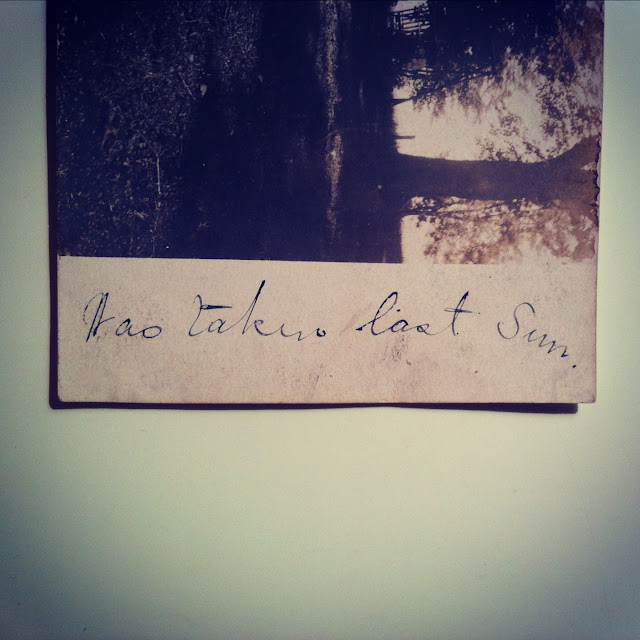
postcards: "Was taken last Sun.," c.1909


I had never made a real photo postcard before, not until that summer when Joe came to stay with us at our country home near Lake Geneva. He brought his newfangled camera with him - obviously his most prized possession. The Eastman Kodak 3A Folding Pocket Camera seemed like a false advertisement, when it came to the matter of pockets, but Joe did not mind at all. He carried the slim black box with him everywhere he went, never letting it out of his sight. And he beamed with pride anytime he could set up the camera to take a photograph or offer a demonstration to a new, interested party. He flushed as bright a red as the accordion-style apparatus which held the camera’s lens, as concentrated entirely on the magic workings of his camera. 
Front: "Was taken last Sun."

Joe had photographic aspirations; he wanted to really figure that camera out, and was tireless in asking us girls to pose for him. Not a difficult crowd to convince: six girls in total, between the ages of fourteen and twenty-two, all here the whole summer long. Always scouting, he coaxed us to all manner of locations. We sat out back on our pair of adirondack chairs on the lawn, posed with one girl on each seat and one on each arm. (The chairs were a new thing, then, still called “Westport chairs,” and a rarity in the Midwest, even among wealthy city families.) Six girls giggling to keep their balance and make sure not to move, in order to show off the architectural features of the chairs: this was a typical photography sitting with Joe. We grouped around the grand walnut double-pedestal dining table in the formal dining room, dressed in our very fanciest attire, to recreate the scene of an important social gathering. There was theater in this art of his - a desire to insinuate something more than what was actually occurring. I wonder now if people knew, as they received their cards in the mail from this sister or that, how much of that was put on. 
Sure, there were plenty of social occasions at our home that summer, but Joe wouldn’t dare pull out the camera on those nights. My father was skeptical of the whole business, and never willing to pose himself, let alone subject his guests to such behavior. Joe came from the same social circles as us to begin with, but his father’s printing company had taken a turn for the worse as he grew, and over the years he had fallen out with most of his well-to-do friends. Momma always had a soft spot for his impish grin: his freckles and golden blonde hair reminded her of the Karl and Fritz cartoon strips in the city newspaper comics. She still kept up with Joe's mother - unwilling to let go of a friendship on the principle of money alone - and had gotten permission from Father to invite him to stay the summer. Just a year older than Joe, I had watched the changes occur in his family's social standing, and seen how his grin grew a little slower coming with each passing year. I was happy to have him with us this summer, to have it all back to normal and just like old times. 
As the summer went on, the rest of the girls grew less interested in Joe’s camera adventures. I became the only one he could coax to travel here and there, the only one to keep him company as he tirelessly worked with his negatives and plotted out what he would like to photograph next. I did not have the heart to turn him down. One hot Sunday in July, he devised a whole new plan. Though Joe always behaved respectfully toward my father, he felt the judgment implied by Father's rules and sense of propriety, which always reminded him of the gap in things, and the question of belonging. He got this gleam in his eye when he wanted to dispute an idea or notion of my father’s, and we might spend the whole day comprehensively discussing one of his old-fashioned ideas. It bothered Joe to no end. So once he got this plan in his head, there was no turning back. We would get my father in a real photo postcard after all. 
Out back, behind our grand, white, two-story country home with its green painted shutters and wraparound porch, the wide, rolling lawn led down to the dock on the Lake. They had cleared the trees and stumps long ago in order to create such a magnificent lawn, but they had left a small patch of woods off to one side. On especially hot summer days, you could find shade there, and my sisters and I loved the chance to play with the leaves, berries, twigs and needles that blanketed the floor of these woods. My father had found his own respite in the patch of woods: the crude double-swing set made by a rural woodworker further upstate. The backwoods man hand-crafted patio pieces from all his own lumber, and while the furniture did not compare with our Adirondack chairs, it became a different sort of collector’s piece. Several neighbors had taken a drive up to the man’s farm 30 miles north of Lake Geneva, to pick out just the right pieces for their summer entertaining. We had most everything you could want already, but Father just had to see it for himself. He came back that day with this double-swing contraption, in two pieces, and set about securing its four long poles deep into the ground beneath the towering trees. 
Every day, in the heat of the afternoon, around two or three o’clock, you could find my father here, always in his long shirtsleeves and proper slacks, resting in the shade of these trees. He leaned heavily into the flat, planked back of the swing, choosing the seat where he could still see the sun sparkling on the Lake beneath the tree branches. He never admitted it, but he always dozed off a bit. He never invited anyone to join him, lest they find him out. But I had snuck by enough times to catch him as his head softly fell to one side or the other, and heard his breath as it caught in just a hint of a snore. On our initial tour of the place, when Joe first came to visit, I had let him in on this small secret, which I knew he, particularly, would appreciate. Apparently, he had not forgotten.
Joe’s plan was to set up his camera behind my watercolor easel, to rig the camera so my father would not notice, if he were, by chance, to wake up. We waited until half-past two, when he would likely be asleep, and tip-toed gently across the lawn. I set up the easel as if for Joe’s benefit, with all manner of brushes and my fancy German ceramic palette, just in case Father were to come upon us and interrupt our plan. I took my place as subject, positioning myself according to Joe’s wild gestures, first this way and then that, until I was exactly where he wanted me. I sat and waited, squinting into the blinding afternoon sunlight, while he fumbled behind the easel to get the camera set in place. My thoughts drifted off, like they do. Before I knew it, he was hissing my name under his breath, gesturing wildly once again - it was done! 
I am not sure anyone ever noticed my father in the background of that real photo postcard; the light is all on me, sitting on the lawn in my long, dark skirt and high-necked blouse with the sleeves pushed up my arms, holding a bit of a leaf or flower, and gazing vaguely into Joe's direction. And I am not sure if he meant to achieve what he did in that photo: the most honest portrait of myself I have ever seen, no smile or set gaze, but a head lost in thoughts and daydreams, too many to capture.


Back: “Dear Friend Arnold, I had this ready to send to New York, but changed my mind so will send to you. Was taken on the lawn at my home in the country. We are having very warm weather here. -Clara” (Addressed to Mr. Arnold Casey, no address, dated July 19th, 1909)

(Click here for more about my postcard prompts series.)


June 6, 2012

postcards: Public Library Chicago, c.1908

When I was shopping for some of my object prompts, I came across SO many amazing vintage postcards, many of which have messages, addresses and postmarks. What a world of inspiration! And so, my next series of prompts: postcards! Similar to my "object" prompts, I will use the postcards as a jumping-off point for a story, as a way to challenge myself to imagine new characters, settings, and stories.
Thomas William Sheffield had cared for Miss Lavinia Watson for as long as he could remember, ever since their meeting at age nine. His mother’s deep ties to her English heritage took them back to Cambridgeshire at least once a year. They usually made their trip in the summertime, near the end of June, just before Chicago entered its two-month humid spell. 
One summer they had postponed their trip until the fall, due to the birth of his sister, whose very inconvenient arrival-timing indicated the issues he would take with her for the rest of her life. Tom remembered that summer well, even though he was only eight years old then. The cheery, gentle springtime patterns of playing outside for as long as the sun stayed high in the sky, and his daily walks to the parks or zoo, gave way to fewer adventures as the weather grew warmer, as his mother’s belly swelled so large he thought she might fall over. They had help, of course, from the servants, and his nursemaid, Alice. But all the help went to his mother and the baby. His sister’s coming seemed inextricably linked with the humidity that settled over the city that July: the new baby girl seemed to reach her way into every bit of his life and grab on tightly with her tiny hands, just as the heavy, humid air seemed to reach into every corner and crevice of their big stone home. 
The only place to escape the thick, wet air was in the basement of their home: the cool, stone foundation walls trapped in a different climate altogether. The air was wet here, too, but in a different way: cool and still and light, instead of swarming and heavy like a mass of flies or cloud of smoke. This space in the house was usually only meant for the servants, but they seemed to have more time for him anyway these days, and did not mind him playing down there as long as he stayed out of their way. He could pretend here, that he was back in England again, but in a castle instead of his Grandmother’s little country cottage. He put a small metal pail over his head as armor, and had his pick of whatever brooms or tools were not in use to make into whatever arms he liked. He learned to play alone, to keep to himself, to stay out of the way - he would file this talent away in years to come, for use only when absolutely necessary. 
The following year, they were back to their regular summer trips abroad. It was warm in Cambridgeshire, too, but it was a dry heat, steady and dependable. Grandmother’s cottage was cozy compared with their own home, but it was “chalk and cheese,” as she would always say, not enough in common to really compare at all. Her home was soft, all fabric and worn wood and brick, in light tones that seemed straight from the earth, while his home in Chicago was everything opposite: dark, hard, straight lines and smooth, new textures of metals and stone. In later years, Tom would wonder that the wealthy, urban society life in Chicago had ever appealed at all to his mother. She seemed so much happier here. 
Their summer in Littleport began as usual: a morning walk (“to wake the body properly”), an early, light lunch of fruits, cheese and bread, and then out to play while the ladies sat and visited for their needlework and tea. “Play” indicated a much broader range of possibility here. No chaperone was necessary as long as he stayed within the town limits, which included the cemetery and churchyard, and the winding wooded path down to the River Ouse. For the most part, his summer friends remained the same: a group of boys near enough his age, whose names he seemed to have to relearn each summer (often nicknames varied from one shared name, such as Jack and John and James). They played hopscotch and blind man's bluff, and hide-and-seek, which offered the most liberating play for Tom, compared with home, having a wild run of the town and a million different hiding places. Sometimes the boys tossed around a pig bladder in games of catch, but Tom had always detested the feel of it, and usually chose this moment as his exit from their play.  
One of these afternoons, when the boys began to form their teams for their game of catch, Tom decided to slip away and do some exploring on his own. He had become interested in plants during his summer spent in the stone basement, after trailing the gardener and watching the maids arrange the florals for the rooms upstairs. So many different types and names - he liked the challenge of remembering them all. It was a good game to play when he did find himself alone that quiet summer, walking round their garden to test how much he knew. It was the biggest change he noticed in his return to England this summer: the even greater variety and vastness of the gardens here. He liked the surprise of these gardens, that he could walk up to a cluster of rosebushes and find a small bunch of herbs growing right behind. His game presented an entirely new challenge here, and his Grandmother had seized upon his newfound passion by contributing her own wealth of knowledge of the countryside flora.
Here, on the winding path towards the river, was where he first laid eyes on Lavinia. She was sitting on a rock, set off a bit from the path, with her back to him, and she was speaking freely to no apparent listener. Her long, brown hair hugged her shoulders as her animated head bobbed forward and back again with conversation. She did not seem to notice him walking by, and so he felt his own sense of obligation to keep himself concealed, and found a tree to block his form from her range of sight as he listened. 
“You see, I don’t really believe in fairy tales. I have never seen a real princess, so how do I even know they exist? My mother says they do, but she has never been able to prove it for me. How do I know those pictures in the newspapers are real princesses?” 
He contorted his body to wrap closely to the tree and this gave him a glimpse of her face: her large, light eyes (he couldn’t tell what color) beneath a strong, smooth forehead, and her tiny, delicate point of a nose above an accordingly delicate mouth. He turned his face away and leaned his ear further in her direction.
“So really, I do believe I will be married someday, and I would like to have five children, because it sounds like a good number. But I am not sure I will ever love him so much as I love you.”
There was no way he could reveal himself now. This had gone too far and he wanted desperately to get away from this strange girl, who spoke boldly into the air in a way he had never heard anyone their age speak at all. He inched back the way he came and walked softly back to Grandmother’s house.
He met Lavinia properly later that summer at Sunday service, when her grandmother happened to approach his grandmother about something for the ladies guild. He smiled and nodded politely and she did the same in return - they both knew what was expected, and grandmothers were best when they were pleased. No further words were exchanged that day, but there was a kindness in her green eyes that kept him thinking of her throughout his days spent in play and gardens.
As summers passed, the play of boys turned into a society of mixed company, as the children again followed what was expected of them and began to see the other gender as their future and not their present. Lavinia and Tom were introduced again on more relaxed terms, and began to run into one another regularly. He had the advantage: this he always knew. He had glimpsed a private moment, that gave him an insight she could not match in knowing him only in their social exchanges. Summer after summer, they interacted trivially and learned casually about one another: that she had a passion for poetry (as he had imagined, despite her loathing of princesses), that he wished to go on to study plants in school, that she knew the best places in the woods for hard-to-find specimens of plants he sought. And they would travel in groups, innocent still in their not-yet eligible ages, children ambling over the countryside to sounds of laughter and teasing.


In the summer of 1907, when they were sixteen, Tom dared suggest to a few of the girls that it might be nice to keep in touch in their long absences surrounding their summers. Tom was quite popular, as the only American boy to regularly summer in Littleport, and every girl obliged his request for permission to keep in contact. He was good like this, in a crowd, able to keep up his confidence for a public eye, just not hers. Throughout that year, he sent one postcard to each of the four girls in their circle of friends. All responded, and he of course liked Lavinia's best: a simple view of Main Street Littleport, that reminded him of his early games of hide and seek. He did not write again, though - he was not yet ready to show his hand.
In the summer of 1908, they took a shorter summer trip abroad, since Tom would now be entering college at Northwestern University. His mother wanted him home and settled well before his classes would begin. They would be in Littleport only for a month this year, and Tom felt the pressure of this shortened time to make his connection. If only he could catch Lavinia on her own, for a conversation between just the two of them. But things were simply not set up that way. A man had to initiate his interest in order to gain a private audience at all. Lavinia shined and sparkled her way through their every interaction, but there was no good way to begin. And every time they spoke, he felt again as if he were outside the walls of her world. They laughed and spoke of future plans, of growing up and traveling to exotic places. And they pledged again, at the end of the summer, to keep in touch.
Tom returned home and prepared to begin his classes at Northwestern, first with a year of college courses, before he could enter the school of medicine. His parents had determined, with only the slightest input on his part, that the closest respectable field to his passion for botany would be to pursue a career as a doctor, or at least in medical science. He spent hours reviewing his old Biology and Chemistry textbooks, and studied often at the Public Library downtown. It was one of his favorite places in the city. He remembered visiting the site as a small boy, watching with his father as men moved sheets of brilliant granite up the steps through the grand entrance with its flanking limestone columns. And he would never forget the first time he saw the magnificent Tiffany dome: the soothing, peaceful pattern of its fish-scale design, the marbled, natural colors in the glass reminding him always of the English gardens he had explored in his summers.  And as he grew, the library’s charms only increased as he came to appreciate the building’s ornate halls and embellished ceilings. When he needed a break from studying, he cleared his mind with laps through all the building’s rooms. As he walked the halls and climbed the curving stairwells, he flashed back to his days in his basement castle, and he found comfort in these pilgrimages, alone once again.
On a warm August day, as he walked from the nearby El stop, he noticed a little stack of postcards on the counter of the newsstand by the library's main entrance. He had thought of Lavinia often, and wanted to write as he had promised, but he didn’t know where to begin. He bought the postcard, along with a two-cent stamp. He sat in the hall of study tables at the library’s center and thought of what he might say. He thought of the line between “not enough” and “too much,” the line he had been walking all these many years. He glanced around him and a flash of light caught his eye from across the room, where a young girl sat with an older man, working over her embroidery hoop as the man poured over a thick green volume. A small, jeweled brooch on her dress had caught the light. As his gaze lingered on her for a moment, he remembered a little rhyme he had seen on a needlepoint one of his cousins had been working over the summer. “What care we for rain or weather as long as we are together.” 


He decided that any beginning was better than no beginning. 
"What care we for rain or weather as long ______________ T.W.S."
A fun post-script on this piece: the former Chicago Public Library at Michigan and Randolph in Downtown Chicago is now the Chicago Cultural Center, and as a part of my writing adventure I decided to spend a little time there in order to get a better sense of my character. There was something absolutely incredible about being able to physically absorb the space I was using as one of my story's settings. I remember, too, visiting the building when I was small, while it was still used as a library, and my memories provided a lovely personal connection as I imagined this character from so long ago.