Showing posts with label objects. Show all posts

August 9, 2012

objects: frigidaire measuring glass

Days spent in Aunt Louisa’s kitchen were the best. They came most often in the summers when Molly was small, when she was out of school and her mother, Alma, was at work all day. Louisa was Alma’s oldest sister, and she and Uncle William never had children of their own. She had always been different to Molly than any of the other aunts and uncles. She bent all the way down to whatever height Molly was at the time, and looked right into her eyes when she spoke to her. Her inflections did not change when she spoke to Molly - her words came evenly, slowly, just like they did for other adults, and the words always seemed to mean more for their deliberation. Molly never minded talking to Uncle Jeffrey or Aunt Helen, or her Uncle Robert, but after she spent time with Aunt Louisa, she would notice how the rest of them talked to the top of her head, in tones that suggested they might be trying to disarm a pouncing tiger. And they always avoided eye contact. 
Louisa was a busy woman, but set aside one day a week for time with Molly. She was part of the set design crew for the local community theater, treasurer of the Garden Club, and a volunteer docent at the local art museum. She was always involved in some benefit or fundraiser or another, crafting or baking to contribute whatever she could. This same quality in her dictated that she would always have something wonderful planned for the days she spent with Molly. Molly looked forward to these days for the whole week between one day with Aunt Louisa and the next. Sometimes they would go on an adventure together, to visit the Field Museum on free days, or the Shedd Aquarium, where they shared in common their favorite jellyfish. Sometimes Louisa would have a project ready for Molly: something they would make of papier mache or a latch hook rug kit. Molly felt important, because Louisa thought ahead. She had learned so many things from her already: how to play poker, how to tie all sorts of different knots, how bowling was scored in television matches, how to tell the weeds from the flowers in the small garden behind the house. 

Molly loved that Louisa planned things especially for her. Secretly, though, she liked it even better when she could tag along on days when Aunt Louisa had one of her own projects to accomplish. She felt important in this tagalong role, rather than playing the guest; on these days, she pretended she was an apprentice to her busy aunt in her exciting life. On the day that Molly first used the pretty measuring glass, they happened to be making peanut butter cookies for the garden club bake sale the following day. Aunt Louisa’s pantry was a source of endless surprises. The refrigerator held her latest cooking experiments, and sometimes Molly found strange fruits, whose names she did not know, in the bottom righthand drawer. Louisa collected vintage cookie jars as another of her hobbies, specifically jars designed to look like old cartoon characters. There was a Yogi Bear jar, a Micky Mouse jar, and Molly’s favorite was the jar shaped like Pebbles’ head: you lifted the bone at the base of her pigtail to open the jar. The hunt for cookies reminded her of the cup and ball trick Uncle Robert liked to play at holidays, as she lifted the top of each jar to see what lay beneath. Louisa was entertained by the challenge as well, and would only give Molly one clue: how many of the fourteen collected jars held cookies at present.
When she baked with Aunt Louisa, Molly’s favorite task, after the taste-testing of course, was being sent to retrieve this or that from the pantry. “Teddy Bear cookie cutter,” Louisa would request, and Molly was off the chair and ‘round the corner, into the pantry in a flash, and back again as quickly as she could find it, timing herself if she remembered. “Two sticks of butter.” Twenty-two seconds. “Flour sifter.” (This was Louisa’s third favorite task.) Eighteen seconds. “Half cup measure.” This one meant unstacking and re-stacking the tall mound of measuring cups: thirty-seven seconds. Today, Aunt Louisa sent her for a new item: “Fridgidaire measuring glass.” Molly sat glued in her seat at the table as she processed the words and scrunched her face curiously: she did not know about this one. Louisa laughed softly and described it to Molly: small glass, painted with stripes, top shelf. Molly unfolded the three-step stool in order to reach the glass. She kept her left hand gripping the top handle of the stool tightly in order to hold herself steady as she stepped her feet back down to the floor, the delicate glass held gently in her right hand. It was the prettiest kitchen item she had ever, ever seen. Five bold, colorful stripes decorated one side of the glass, and the opposite side listed the name of each color in lowercase print, romantic names like “sunny yellow” and “aztec copper.” It looked like a glass just her size, but was painted with marks for ounces and cups. As they filled the glass with flour and then the sugars, Molly noticed how it fit the palm of her hand just right.

Another thing she loved about Aunt Louisa: how everything she seemed to own was not just functional, but also pretty to look at. In Molly’s house, most things were good for use-only, nothing noticeable or pretty about them, nothing to differentiate them from the contents of every other kitchen. She knew this was because they did not have much money, and her mother always said that “All they needed was just enough.” She didn’t really know if Louisa and William had lots of money - all their pretty things seemed to have a use as well as artistic value. She asked Aunt Louisa now where she had found the new glass, and Aunt Louisa said it had been a free gift from the department store where they had been looking at a new refrigerator. They had decided against it, and if they had got it, it would only have been plain old white, but weren’t the rest pretty colors to think of? Molly couldn’t think of anything prettier. She imagined an entire “mayfair pink” refrigerator in her own small apartment kitchen, and it made her just about crazy to think of how wonderful that would be.
Not much had changed in Molly and Alma’s small apartment for as long as Molly could remember. Her father had left when she was four years old. Her memories of her father corresponded mostly with pictures in the photo album her mother only let her look through once a year, on her birthday. “Birthdays are a time for contemplation,” her mother said, “and knowing where you came from, even if it’s a hard thing to know.” Molly spent hours on her birthdays with the album open in her lap, memorizing the angles of her father’s chin, the exact brown shade of his eyes, noting the ways he changed from a teenager into a man throughout her mother’s time with him. He was gone now, long gone, and hadn’t so much as sent a card in the time since. Molly believed deep down that all those smiles in the photos had been his way of sending cards in advance: the smile he gave from the back of the pickup truck was for when she would turn eight years old, and a few pages later, he beamed his bright smile from the sofa for her twelfth birthday. Now, at age ten, she had that one to look forward to. There were thirty-seven total smiles in the album (she didn’t count the pictures where he was not smiling), and another secret belief was that perhaps by her thirty-seventh birthday, so far in the future, he would have somehow found his way back to her. 

She sat all the way back on the brown corduroy sofa, mindful of her posture as she opened up the rectangular blue vinyl photo album, embossed with gold lettering on the front that read “Family Album.” It felt more official this way, more respectful of this annual event, to sit with her straight back at attention. All her sense of what “family” even meant was contained in those sixty-four pages. She squinted her eyes at the laminated pages, to help her memorize the images as she tilted the book against the glare cast by the lamplight. She turned the pages gently, slowly, noticing how the golden corners were beginning to separate from the edges of the yellowing pages. She fought the impulse to peel back the corner of the protective covering, knowing it would never stick the same if she did, because she had experimented with this. One year, she had snuck a picture from the album in between the sofa cushions, with a plan to hide it under her pillow later so she could see his smiles all year long. But her mom must not have applied the same birthday rule to herself; a couple of days later, she sat Molly down to ask where the missing picture went. Now she flipped through all the pages once Molly was through, and made sure every picture was accounted for, before returning the album to its secret place in her bedroom.

Molly was sure that Aunt Louisa would never have handled it this way. Every question Molly could think to ask, Louisa answered as honestly as she could. Molly learned to save up her questions for Louisa instead of Alma, and when she was nine she even started writing them down in her new diary, which locked for privacy so her mother wouldn’t see. Molly asked Louisa why the father of the family that lived above them wore a little cap on his head and grew his sideburns out in long curls. She asked why their church had a statue of a cross, with Jesus being tortured on it, when that seemed like the violence her mother did not want her to see in the movies. She even asked what curse words meant, when she didn’t know their meaning. Always, always, Louisa gave her honest, direct answers in reply.
A few weeks after Molly’s first glimpse of the measuring glass, she was overwhelmed by the desire to have it for her very own. Nothing at Aunt Louisa’s house had been like this before; everything lived in its place and wouldn’t seem right anywhere else. But this glass seemed made just for her, and after all, they were not even shopping for a refrigerator anymore. Louisa had plenty of other measuring cups. Molly thought about asking for it directly, but she knew her mother would frown on this, and remind her of the rule of “just enough.” Surely this measuring glass would not qualify. She thought of asking to borrow the glass, to make her own cookies at home. This might feel like a compliment to Aunt Louisa, and since she really didn’t need the glass herself, she thought it might work. But the more she thought about the glass, the more Molly didn’t feel like she could take the risk of a request not granted. If Louisa said no, she didn’t know what she would do.

The next day spent at Aunt Louisa’s house, Molly asked if they could bake some cookies again. She caught Louisa off-guard with the request - she had always been a child to go along with whatever was planned, with a cheerful spirit, especially since Louisa always put so much thought into it. But her request was reasonable and Louisa decided to try to grant it. They had tickets to a matinee performance of “Pinocchio” at the community theater, but if they returned home with enough time, they could whip up a quick batch together before Louisa started making dinner. They returned that afternoon as planned, and this time, Louisa gave Molly the option of which cookies to make. Her kindness weighed heavy in Molly’s stomach, blocking up her throat a bit as she reminded herself of her goal. “Chocolate chip,” she announced, as if she had been deliberating this whole time, and reassured herself again that she was not really going to hurt anyone with her plan. “Flour, sugar, baking soda, salt,” Louisa read from the recipe, and Molly carried them to the kitchen table, one arm around each matching canister, in two trips. “Four sticks of butter.” (They had decided to make a double batch so that Molly could also bring some extra cookies to her neighbors, causing her heart to sink just a little bit deeper.) Twenty-four seconds. It was almost time. “One cup measure.” And here was the moment of execution. Molly entered the pantry and pulled out the pane of glass from the photo frame at home, which she had tucked on the bottom shelf when she had arrived that morning. Holding both sides of the glass, she raised it up as high as her head and let it fall to the floor with a crash. 
It was another thing she loved about Aunt Louisa: the way she always let Molly figure things out for herself, if she wanted. When she worked a latch hook pattern and got mixed up on where she’d left off, Louisa waited for Molly to ask her for help before telling her how to fix it, and usually Molly found her mistake on her own, and was back on track within a few minutes. When they made the papier mache hot air balloons, Louisa didn’t mind a bit that Molly chose to shape hers with sharper edges than Louisa’s. Where her mother would have stepped in and instructed Molly on what was most normal or most right, Louisa held her tongue and rather let Molly tell her what she needed. When Molly broke the glass, Aunt Louisa called out to ask if she was OK, and when Molly said she was, she let her be. Molly’s tears were real as she came out of the pantry with the dustpan full of glass, quickly emptying the pan into the trash bin. Her apology was genuine: she was really, truly, so sorry about the measuring glass.

(Learn more about my "object" prompts here!)

June 28, 2012

objects: dollhouse sink


I have always wanted a real dollhouse. I want it to be bigger than I am, but I will settle for anything, as long as it has several rooms. I will glue wrapping paper on the tiny walls, like wallpaper, and cut up scraps of old towels for rugs. I dream of glueing  postage stamps onto the walls, just like in The Borrowers book, framed with tiny pieces of wood that I will paint gold. I will be decorating with themes: hunter green for the living room, of course, and a burgundy dining room, to compliment the wood tones of the oak dining set I also hope to have. The bedrooms will be taupe and butter yellow, neutral for parents and guests sleeping over. The guests should have the yellow room, to keep them cheerful while they visit. If I am lucky enough to have a third floor, with the children’s rooms, those should be powder blue for the boys and bubblegum pink for the girls. I would prefer a cornflower blue house with white trim, and I especially like the Victorian ones, especially the ones with the big porches, even though you can’t really decorate a porch as much. (If I could, it would be with white wicker chairs with flowered cushions and a matching table.) 
This little pink sink set is sort of a start for my dollhouse, even though I really prefer slate blue and white for my dream kitchen. I figure I can paint it, if I have to, or maybe one day I will be able to afford the fancy sinks I see at the craft store with Aunt Elisa. Aunt Elisa is not so old for an aunt, she is only fifteen years old, just seven years older than I am. But Mama says Gramma had Aunt Elisa TWELVE whole years after she had Mama. Thankfully, Aunt Elisa’s friend works at the craft store, and she is nice enough to bring me along once or twice a week when she visits Tianna here. We walk hand in hand for eleven blocks, mostly along side streets until at the last minute, we turn left and are right in front of the store. There is a smell, when we enter, of glue and dried flowers and wood. There are so many colors here, you would think there would be more smells, but you can’t really smell glitter, and the paint’s all closed. Sometimes, to give my nose a rest from all those old smells, I go to the little shelf by the cash register, with all of the scented erasers in their clear plastic tubs, like jars of candy. The strawberries are pretty awesome, sweet-smelling and so cute, just like the real berries! And I always have to pick up the popcorn one too, since that is the weirdest one to smell. They never get it right, but it always is weird, just like the popcorn jelly beans taste. 
Our shoes make clomping noises over the wooden floor as we “Watch Our Steps!” over the place where the door used to be. I just learned what that means, but I think it is really silly because if I am watching my steps then I might bump into something with my head instead of my feet! Lots of things can be bumped into when you are only eight years old, and I worry most about my head. It has been bumped too many times already, I think. We enter the second half of the store, where the aisles get a little more crowded and certain places seem to not really have much light. This is exactly where I want to be: with the dollhouses. The dollhouses themselves are up on the wall, almost too high for me to see. I wonder who built all of them? They did a great job, they are beautiful. They must have nailed them to the wall since they are so big, and the store is so crowded already. I wish they were lower to the ground, so I could see better inside their rooms. But I kind of like to be able to see them from far away, too, so I can tell what they would really look like, if they were in my room.

I could spend hours looking at the dollhouses and all of their furniture and accessories. This section is different than the other sections: instead of only walls with hooks and pegs so all the bags of stuff can hang off of them, the dollhouse area also has an amazing glass counter. The top and the sides are both glass, so you can see the furniture inside, front and back. It helps me to imagine what they will look like in my house. The furniture in the case is the really fancy stuff: the miniature pianos and fancy dining sets and some of it is even made from marble. There is other furniture on the hanging walls, sealed in clear plastic bags with folded cardboard labels for hanging. The hanging walls are where the accessories are, too, and I can’t even believe all the things they have. Tiny records, and a record player. China dishes that are fancier than anything anyone I know has in their real houses. Tiny clocks and even little newspapers and magazines. I add all these things in, when I dream of my dollhouse. 
I first found my pink sink set at a garage sale. Mama and I were walking to the grocery store and passed one of the houses where the garage backs up to the alley. I said “Mama, look! A garage sale!” It was across the street, and I wasn’t sure she would want to stop. She was tired because she just got home from work. I knew that if I asked her, she would probably not stop. But she must not have had the worst day today, because at the next street, she grabbed my hand and we crossed over to look at the garage sale. We didn’t hold hands very much anymore, since I was getting big now. I was glad that we still needed to sometimes, for safety reasons. The garage sale didn’t have much. It was one of those ones that really only have stuff nobody would want anymore. There were old magazines and small, beat up paperback books, and old brown fake leather cases for cassette tapes, with no cassettes inside. It seems like maybe a waste of effort to even try to sell this stuff. 
Under one table, there was a box of toys - mostly happy meal toys that a lot of kids already had. I had the one that was a cheeseburger that transformed into a robot, and the stuffed crab from the cartoon movie, and the tiny mint-green My Little Pony. She was not as nice to hold as the real ones, but I still liked her pretty well. And then I saw this little pink thing in the back corner of the box. I reached my arm in up to my armpit in order to grab it. Mama was starting to walk back to the sidewalk and she was kind of looking back, telling me to hurry up like she does, with no words. And then I had to think very fast and figure out how I could get the sink. The box had “25 cents each” scribbled on its side with black marker. I hoped she had a really good day at work. 
“Mama, look!” I had to try to get her to come back and see it. “Come on, Maya, time to go,” and now she was starting to frown at me. “Mama, this is so cool!” She sighed and her frown grew deeper. I smiled the biggest I could, and walked slowly toward where she was stopped at the edge of the alley. I didn’t want anyone to think I was going to steal it or anything. I held it up for Mama to see. “Mama, look at this! It is sooooooo cute. The drawers don’t open or anything but I think it is really cute.” “How much?” I was ready for this. “Only one quarter, and my birthday is coming up and so I think I can pay you back then.” Mama’s cheeks puffed out with her slow, irritated breath. “Fine, OK.” “OK?!” “OK.” “Thanks, Mama! I promise I will pay you back right away.” She reached into her pocket and pulled out three dimes. I paid the lady who sat inside the garage at the card table, and held tightly to my sink as I waited for Mama’s change.
Later that night, once we got home from getting the groceries, and ate dinner and cleaned up, I went to my bedroom and climbed into my bed. I laid on my stomach and just stared and stared at the sink. I thought about the drawers opening, and the things I would store inside the cabinet doors (cleaning stuff, probably, since there were pipes in there and all). I thought about how I could make a tiny dish rack to go on the counter part - I had never noticed one of those at the craft store. One of my friends made a whole entire dollhouse out of cardboard: old cereal boxes, milk cartons and berry baskets. She used tissues for the curtains and blankets, and cotton balls for the pillows. I know she worked hard on it. But it was hard to make it not look like a bunch of trash, and so I spent a lot of time thinking how I could make my own dollhouse feel nicer than that. My pink sink makes me even more excited!
I practice my decorating with the big Sears catalogs, tearing pictures out carefully and making piles of the things I like the most. The next thing is sorting them into pages, where I create my room themes. I paste them to scrap pages of paper that have stuff Mama doesn’t need anymore on one side of them. No one here really uses the Sears catalogs, so they are all mine to use and then throw out when I am done. I have a hard time getting rid of them, usually, in case I might need something later for my rooms. I especially love learning all the different colors in the catalog, because they inspire my rooms. My favorite catalog-designed room so far is one of the bedrooms. I haven’t decided yet if it will be the parents’ room or the guest room. It has a four-poster Oak bed with a matching dresser and the most beautiful quilt I have ever seen: all ivory with embroidery that looks like lace. That page is almost completely full. Not many people want to see my pages. Sometimes I show my friends, but they are not really into decorating so far. And none of them have real dollhouses, either. I don’t know if they really think about them. Definitely not all the time like I do.
I think about my dollhouse when we are walking places, when we are passing houses and the people who live in them. I think about it when I am playing outside with my friends, in our dirt backyards, shaping sticks in the dirt into house shapes. And I think about it in my room, laying on my bed on my stomach, when the screaming starts and gets so loud that it is hard to think about anything else. I think about my house, and I keep my little pink sink with me all the time, to remind me that just like the Cinderella song from the movie says, “If you keep on believing, the dream that you wish will come true.” 
(Learn more about my "object prompts" series here!)

June 13, 2012

objects: yardstick

We gathered with our cousins that Thursday to clear out Grandma’s small house on Linden Road. Mother had prepared her most politically-correct suggestion: each grandchild could choose just one item of Grandma’s to take with them, but any remaining item of their choice. Mother always worked through things in an order that began at practical and eventually ended at emotional. She kept her emotions private in this way, facing it all herself only once all of the public and social expectations were long past. The aunts and uncles had already taken what they wanted from Grandma’s, though looking around that day, I didn’t notice anything missing. I must not have paid enough attention; what does that say about me? Sad, how a person makes so many choices to arrange their world around them, with no guarantees that anyone will even notice, let alone remember once they’re gone. I look around again and focus instead on all that I do remember: the dark mahogany upright piano, the orange upholstered wingback chair, the lovely grandfather clock in its regal, carved wood casing. The rest of her things would be sold off in the estate sale this weekend, to help pay the bills that were left from the funeral. 

The picking would begin with Louis, the youngest, as Mother’s reasoning suggested he had spent the least time with Grandma, and might have less connections, therefore, to her things. We would work our way up through our ages after him. Louis chose a wooden vintage radio with black dials worn shiny from regular use. The radio used to sit on the tiny green formica-topped kitchen table, so Grandma could listen to the oldies’ station as she washed the dishes each night. We let Patty pick long-distance at number two, on a phone call from Portland. She chose the three-tiered rope macrame plant stand that hung in the corner of the living room from the ornate gold ceiling hook. A very fashionable choice - Patty was always informed on the trends. On and on our choices went, through all seven grandchildren: a marbled ceramic lamp; a full poker set in a round, red leather case with gold snaps; a bonsai tree planted in a rough cement planter; and an etched mirror that had always hung in the front hall. Their choices matched their personalities perfectly, ranging from understated to ornamental, from small to large, from sentimental to valuable. In my role as oldest grandchild, I chose last. I knew just what I wanted, though I knew no one else would choose it. I had to look around a few places to find it, but finally my eyes caught its form, tucked into the corner of the spare room closet: Grandma’s old, battered yardstick.
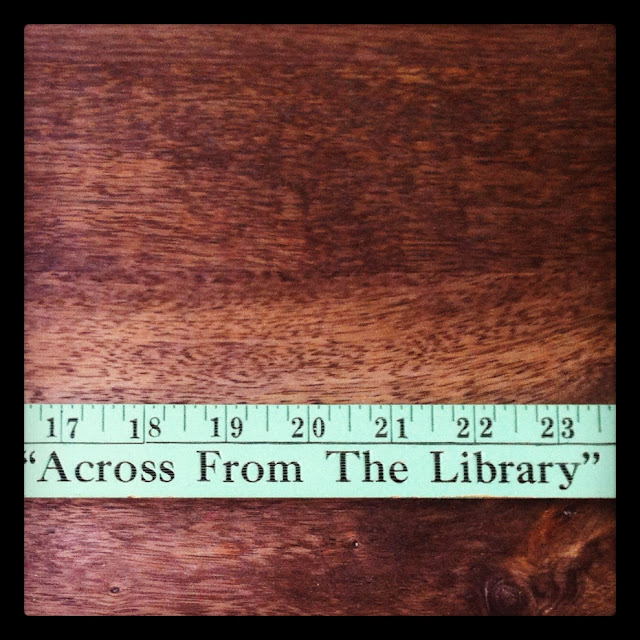
The wooden yardstick’s edges were worn and slightly splintered from all its years of use. It was painted a dusty shade of bluish-green, printed with black letters that had worn through to show the pattern of its wood grain below, the same message pressed firmly into both sides. Grandma had the yardstick for as long as I can remember - I have no idea when, or where exactly, she got it. Yardsticks are the sorts of things that seem to come from nowhere, but are always with you, like a subsidiary family member, floating from room to room throughout the years, always belonging, but never stealing attention. It was always handy for a school poster project or for Grandma’s sewing stints. Her yardstick obviously must have come from The Carpet Center - perhaps she bought her carpet there long ago? Or maybe it was a promotional item, given away at the local hardware store as a way to draw more customers in? No one seems to have any idea of its origins, nor does it seem anyone cares to care, except for me. But we can all attest to the faithfulness of its company through all our growing-up years. I loved all the marks the yardstick had collected along the way: bits of pencil and Sharpie marker and an occasional ballpoint scribble on its painted surface, where a little brother or sister had “helped” with a project. 
The Carpet Center had closed when I was in elementary school. It was located on a small, triangular plot of land across from the library, off a main thoroughfare that edges the residential neighborhoods including our own street, Gottschalk Avenue. “Got chalk?” we quipped, when the milk campaign reminded us of our street name. We lived in an old brick apartment complex, just a few blocks from Grandma’s. We were free to roam the neighborhood as we liked, as long as we stayed within the confines of the major surrounding streets. Luckily, this included our house and Grandma’s house, as well as the Dairy Queen just around the corner from her. She was generous with her Bingo prize money anytime she had a winning streak, and would grant us each a dollar like we had somehow contributed to her success. The only thing I really remember about The Carpet Center was the fact that we could ride in triangles around the store on our bikes, without crossing any streets or alleys, just the loading driveway at the back of the shop. There were not many places in our neighborhood where you could track your progress so neatly, so simply. The triangle-block made the best race-track for all of us as we lapped around and around the block’s three sides, feeling wild and adventurous outside the usual square-block paths. I wonder if they paid any attention, from their desks inside the building, to the parade of children: varied bikes and sizes, taking turns in the lead.
“Delusions of grandeur,” my father always said, about our humble town and its street names that conjured up images of other places. “Park Avenue,” with its reference to fancy New York City, or “Vincennes,” which was most well-known for being a nearby Indiana town, but actually referred originally to a suburb on the outskirts of Paris. I had done a research project on Vincennes for school, and learned that the French town boasted both a zoo and a castle, where the Marquis de Sade was once imprisoned. I could only imagine. It was just like our town, to move your thoughts on off to something else, something far away and most definitely better. Even “Western, Kedzie, Ashland and Halstead” made you feel as if you were just a stone’s throw from the city limits where those streets belonged, when in reality, it was at least a thirty-mile drive. It always bothered me especially that one of the nearest main roads was called the “Dixie Highway.” Wasn’t that the worst of all? We had learned early in school about the Civil War, and what I learned then had already ruined one of my favorite songs on the Disney cassette: “Away, away, away down South in Dixie!” So upbeat, so triumphant, so misleading - it almost gave you understanding for those poor Confederates. Maybe the song was what had kept them going. I still loved it secretly, but felt the impropriety of claiming sympathy for the southern slave-states’ case. What was a “Dixie Highway” doing up here in Illinois, anyway?
Grandma always laughed at my literal approach as a child, the way I needed to understand a word all the way before I felt confident to use it. She had long let go of taking herself too seriously, back when she had come to America in the first place and had to learn English as a part of their new start. I helped her cook, and garden, and watched over her shoulder as she mended Grandpa’s clothes. I was satisfied just to watch, to ask her questions as I thought of them, and to catalog my observations in the neatly-organized file cabinet I liked to imagine inside my brain. But she always poked and prodded me to participate with my hands as well as my head: “Here, now you try.” My mother tried to do the same, but she watched too eagerly if I indulged her request, waiting to coach and correct my attempts, and then I would always, always fail. Grandma knew to look away, to keep her own hands and head busy as I mimicked the way she poked the tiny needle through the hem and pulled the black thread neatly through. “Good, Baby. Good.” she murmured, only once I was through. I am not sure all my stitches were good, or my plantings, or the blends of spices that I chose. But she never once betrayed any lack of confidence in my abilities. I already missed her soft affirmations, and protected them fiercely in my own memory to preserve them.
Grandma’s yardstick read THE CARPET CENTER in bold, capital lettering, followed by the address and then their well-known quote: “Across from the Library.” They had listed the phrase on all their advertising for the store, and over time it had rolled along enough different printer’s desks and newspaper ads to collect the quotation marks like a tumbleweed catches bits of leaves and debris. The shop is long-gone, but I wonder if it would have collected more quotation marks over time, the longer it was open. Would it work like that for me? Could I live a large enough life, and long enough, to garner quotation marks attached to my name? It struck me silly even when I was small, those pretentious quotation marks. Although I suppose they could have been legitimate; perhaps the quote had originated from the shop owner’s wife, who spoke them approximately thirty times a day into her light blue telephone receiver: “Across from the Library.”  
Everyone knew where the Library was. It was as good a landmark as any. After all, carpets were not the sort of thing that people shopped for regularly, and while a name like “The Carpet Center” guaranteed a clear offering of products, it did not do much to distinguish itself from other carpet retailers in the area. Homewood’s place as a part of Cook County meant the shop was included in the giant phonebooks, as well as the local ones. The free books, most commonly used as booster seats for children or step stools for housewives, showed up once or twice a year on everyone’s front step, in shades of yellow and white, and almost always decorated with accents of blue. Turn the pages to “Carpets,” and there it would be, three pages in, a square box interrupting the rest of the column, containing the same famous quotation. 
In the front hall of our apartment building, the phonebooks arrived in numbers, more books than apartments, it seemed to me. The books formed stacks tall enough for us to climb on, and I always wished I could measure them with Grandma’s yardstick, to see just how high they could tower when all stacked together. The yardstick was my favorite tool when we were small, before any line I drew freehand could even begin to resemble something straight. I liked the dependability of it - the way you could count on it to be a firm and steady guide for just about any line, and it would just keep going. I would lay the yardstick down on top of my poster paper, on Grandma’s linoleum dining room floor. Once it was positioned straight, I used my knee to keep it in place underneath my body, as I stretched out toward the top to begin my long, straight line. As I grew older, it came in handy for making charts, or for craft projects where you had to measure a string or piece of paper just right. You could measure just the same with a tape measure, I suppose, but there was the element of flexibility which made it so much harder to guarantee an accurate reading. The yardstick never bent, never changed. My friend Ana had a fancier yardstick at her house, marked with both centimeters and inches, while ours was only marked in inches: one to thirty-six. But who ever needed centimeters anyway? I never missed them.
My choice confused my brothers and sister and cousins. They knew me to be practical, sure, but hadn’t I been the one to share the most with Grandma? The most years, the most of her attention before there were others to compete. Their skepticism registered on their faces and a couple of them expressed it verbally: “Are you sure that’s what you want?” Surely there was something more ‘important’ I could claim. I wanted the yardstick for a reason I couldn’t manage to explain, for fear that it would undo me and let loose the wall of grief that had flooded up behind my older-sister dam of comfort and dependability. 
I valued the yardstick as a reminder that Grandma kept track. We couldn’t keep her house, or the wall in the upstairs hall that bore each of our growth marks. But I could hold on to the method she used to make those marks, year after year, as we celebrated our birthday and walked again to the wall to measure our year of experience in inches and feet. I remember the year when she had to make two marks for me: first, a tiny dot where the yardstick’s thirty-six inches had ended, and then the proper line, marked with my name and age, where I had exceeded its reach by two extra inches. I couldn’t believe I was finally longer than the yardstick! I remember when my brothers grew taller than Grandma, when she held the yardstick flush against the wall and pointed, as they turned around to mark their line where she could not reach. I remember the year Patty turned five, her triumph at finally passing thirty-six inches - she was always small for her age, and this self-consciousness was emphasized by her analysis of the walls with their marks from the rest of us as we grew. 
And I remember my own last mark, the year I turned twenty-one, which Grandma had determined as the age we would be fully-grown. In my last year of school, I was beginning to understand what growing up might really mean, and that I wanted my life to count in ways just as tangible as the marks on Grandma’s wall. Grandma added my age to the line that had held its place for several years now: five feet, five inches, four inches taller than she was. She touched my cheek, with her left hand and said nothing; she didn’t have to, her eyes beamed bright and proud at the woman I was becoming. Most of the kids looked at the wall as something they had done for Grandma, year after year, humoring her old-fashioned whims and routines. I looked at the wall as something Grandma had done for us.

(Read more about my "objects" writing prompt series here!)

May 29, 2012

objects: Noritake Lemon Plate, c.1918

Writing prompts have always been one of the best ways to push myself outside of my comfort zone in my work - a way to challenge my brain to follow some new paths and reach into deeper corners. I have some books filled with prompts, and might share some of those along the way, but what I am really excited about right now is a series of "object prompts." I will combine a couple of my favorite hobbies: treasure-hunting and writing, in order to see where the writing might lead. 


This first "object prompt" is a Noritake Lemon Plate, c. 1918, which I found at an antique shop. It caught my eye and connected with me from the moment I spotted it, but I must admit I was not entirely sure what it was! I had never before come across a 'lemon plate,' and it just might change my life forever, hehe! :) Hope you enjoy the piece that came from this special prompt.


"The Lemon Plate"


It was time to serve the tea. The ladies’ luncheon had ended, and Eleanor, her co-host, had already brought the silver, tiered dessert stand to the table of eight, where the other women pretended not to notice and thought of nothing else. In the kitchen now, by herself, leaving her friend to keep the conversation going, Colleen squinted her eyes and rattled her brunette head quickly side to side as she leaned over the counter and tried to remember. “What else? What else?,” she murmured softly.  “Teapot, coffeepot,” (they liked to call it ‘tea,’ since it sounded so much more European and formal, but there was always more coffee poured than tea, not that anyone would admit to paying attention) “cream, sugar cubes, with a tiny spoon for serving.”  And it came to her, right in order. She had studied the list at least fourteen times for this very reason.  “Lemons. Lemons are what.”  She had forgotten to slice the lemons.  
Quickly, she took the long butcher’s knife from the drawer. She hated to look at it, hated the “weapon-ness” of it, but it was the quickest thing to do the trick. She set it on the counter and grabbed two lemons from the icebox; surely the women would never get through two lemons, but you always wanted to be sure it looked like ‘plenty,’ when it was your turn to host these sorts of things. A quick rinse of the lemons, each one sliced twice longways, “Ah, here we are.” It helped her to talk herself gently through even the simplest of actions, while he was away. So much silence, so much missing him, and always, always missing her mother.  These verbal instructions were the most she herself could sound like her own Ma’s soothing, nurturing tones. But no silence now, not with the house full of church ladies. “You had better keep your mind straight, Colleen.”
She had worked herself up to this moment, had anticipated its difficulty even as she was aware of its absurdity. He had sent her a present. He had thought of her and had sent her a present. How many of the women had already bragged about their own gifts from afar, their own war-tokens filling the stead of their men while they were away. And now it was her turn to hold her gift, loud and proud, to share how he had thought of her. She pulled the tiny dish from the shelf above the sink, where it had sat, untouched, since she had opened it. Five and a half inches in diameter, its smooth white center outlined with a thin gold circle and rimmed in a creamy shade of ivory, the lemon plate was decorated with tiny flowers and flourishes in exactly ‘her’ colors: gold and coral tones, with a hint of blue. He knew her well.
It wasn’t the smallness of the gift that upset her - she knew he had gone to trouble just to get her anything at all. It didn’t matter what the other ladies had received, she knew he had done just what he could. She set the plate on the counter and moved the lemon slices quickly, arranging them as neatly as she could (it was really too many for the plate, but that’s how “plenty” goes, she guessed). Her righthand index finger deftly hooked into the tiny handle of the plate, and deposited it gently on the wooden tray. She thought again how the plate resembled the candleholder stored in her imagination from her favorite childhood poem, “Jack be nimble.” Her mother had whispered it gently to her each night as a sendoff to her sleep and dreams. In third grade, she had learned in school the meaning behind the poem: One could expect good luck to follow if one could clear the candle on a jump and not blow out the flame. 
She had met her own Jack in her high school years, though not in school. She worked at the local wool factory and noticed his tall, broad frame coming and going from the building next to hers. All the girls knew him, all the girls wanted him, with his wavy dark brown locks always spilling over his brow and his twinkling grey eyes always in on the joke. When she mysteriously caught his attention (he never would say how or why), it was clear he knew he had only to say so, and she would be his. And it happened just like that. She should have played harder to get, perhaps, she should have questioned more and trusted less. But she had made her choice, and here it had all led, to an afternoon spent hosting the church ladies’ luncheon with two babies sleeping upstairs and letters that only came once a month.
Now was not the time to think, but oh, did she know him well. She knew he did not believe in gifts for no reason, but as penance, tokens of affection to make up for what had been done wrong. Her painted lacquer compact, her lovely tortoise-shell hair comb, her ruffled pink apron: each held an offense, but each had been forgiven. She had almost come to love them, these little proofs that they could heal and make amends. But her breath had caught when the small box wrapped in brown paper had arrived for her, and she bit her bottom lip hard as she tore away the paper and found the little plate. So far away, so out of touch, she didn’t know the reason or the sin, but she knew her husband, knew him well, and knew, too, she might never know why. 
Her hands tucked strongly underneath each handle as she lifted the tray and turned swiftly on her left heel to push her shoulder against the kitchen door. “Here we are now, ladies, tea is officially served!” She deserved better, perhaps, but she had chosen, and that was all. 


Best not to think on it too much, and best to keep the lemon plate tucked in a drawer from now on.