June 15, 2012

writing practice: every thought counts

When a thought comes to mind, any line or idea, write it down it at once! I have lost so many ideas and lines, despite swearing to myself that I would manage to remember them later, simply because I failed to write them down immediately. Every line I lose reminds me of this basic, necessary writing practice of writing it all down! If the line or idea is not great, you will know when you review your thoughts with a fresh perspective later - no harm done. If it is great, you will be so glad you held on to it tightly!


Whether in a tiny notebook you carry with you, or in a memo app on your phone, or scribbled on a napkin and stuffed into your purse- write it down! Perhaps the line is the beginning of something important, or perhaps it is the thought that stands in the way of the next thought, which might hold even more potential. This process of recording thoughts also reinforces my belief in myself as a writer, reminding me of my purpose and practice. Carrying some sort of notebook is the best way I have found to hold myself accountable to practice listening to my creative brain. It is also a way to validate the thoughts that pass through.
I try to pick up little tiny notepads when I come across them at stationery or gift shops or even stores like Target or Hallmark. The important thing is that they speak to me in some way, nurturing my sense of myself through style or affirmative words. These notebooks remind me of where I want my head to be, of the importance of keeping my writing at top of mind as much as possible. (Ryan does the same with voice memos on his iPhone or a handheld recorder, if it is nearby; his practice has definitely been an inspiration to me!) The notepad I carry with me in my purse right now is this one, which I found at the Huntington Library and Gardens gift shop in California (one of our very favorite places!).
You can see it is kind of battered - I take pride in that! It is worn because I carry it with me everywhere I go. And it means that I am using it, hopefully, which is exactly the goal. The messages on front and back, “Live in Hope” and “Hope Doubles Everything,” are thoughts that encourage me every single time I read them. And I originally picked the notebook out because of the pretty hot air balloon filled with forget-me-nots, a flower that reminds me of my close friends who I want to treasure forever. The binding at the top, which is pretty worn out by now, has the words “love” and "bliss" written in the clouds, which is another detail I absolutely love.  Sometimes I will choose a simple notebook, like the tiniest size of Moleskine journals, which are perfect for pockets or wallets as well as purses.  
Inside the book, I am loose with my expectations. I try to date everything I enter, because I think it is interesting to see when I return to ideas and pick them back up again or decide to use them for a writing project. But I do not worry about neatness, or even logic. I do not worry about where the thought will go later. Sometimes I enter just a brief description of an idea, like this one:
And sometimes it is a line that comes to me, a full run of connecting words, and I try to record them just as they come, without editing, whether or not they make sense. Like this one:
Many times, when I am sitting down to write and void of inspiration, one of these lines will help jumpstart a topic or idea for me! Or sometimes a line will be so persistent in my consciousness because I have given it the attention of writing it down, and this obsession will bring me back to the page all on its own. 


I hope that you are catching your thoughts somehow and writing them down! You can truly never know where they will lead.

June 14, 2012

artist date: morton arboretum

This week, my artist date took me to the Morton Arboretum. It was a lovely day, sunny and warm but with a soft breeze, and I was eager to spend some time enjoying such a gift of a day. I have been to the Arboretum several times over past years, and have taken a couple of artist dates there before. But it has really been a mostly untapped place for me overall. I was excited to see what new experiences I might have there!


I began by choosing which side of the Arboretum property I would explore. Glancing quickly at the map, what caught my eye were the "Fragrance Garden" and the "Willow" trees. I chose the West Side of the Arboretum. For my artist date practice, I really have to keep myself from planning too much. The most I usually let myself plan in advance is the destination and perhaps functional information like what hours they are open or where to park. As much as possible, I embrace the adventure of the date, and let my creativity guide me as I go. 


I chose to walk to my destinations instead of driving to the other parking lot, and here are some of the things I enjoyed along the way...
I walked through this tunnel, and the vines creeping over all the edges were so romantic and charming - I felt transported! While I was in the tunnel, a mom and two kids rode by on their bikes. When they entered the tunnel, they began to hoot and holler. Their fun was contagious!


Then I came upon these two spots: this trellis with climbing vines felt like something straight from an old European garden. It was just sitting off the main road, in an unfettered area, minding its own business. The little red berries reminded me of my uncle's strawberry plants when I was young. The berries and their vines crawled and climbed everywhere, covering the ground like weeds: uncelebrated, unremarkable. But their color cheered me instantly.
As I continued to walk, two practices came into clear focus for this date. First, I was taken by the transportive element of the gardens and meadows. Within a few steps' walk, I felt like I was in an entirely new world. Just a few steps after that, my setting would change again. What a wonderful way to soak up inspiration for my writing! To let myself simply absorb the changing worlds around me and let my imagination run free... it was absolutely blissful. The second quality of my date that I embraced was to practice using all of my senses. As I walked, the scents grew clearer and more intoxicating. All throughout my date, there were new scents wafting gently through the air. The scent that struck me the most was a mix of clover, grass and earth - a fresh, green, earthy smell that was sweet but not sugary. The scents caught me so off-guard that I couldn't help but pay attention to the sensory aspects of my experience. I reminded myself often to listen more specifically to the sounds that filled the air, or to look closer at the lovely flora I was passing as I walked, or to reach out to touch the bits that caught my eye: a leaf, a tree stump, a wooden bridge, a stone wall. 
This doorway is on a back side of one of the exhibit buildings at the Arboretum, but the sight of it immediately transported me to worlds beyond my daily life. At first, I thought the moth had been caught in the cement as it dried, but it had simply chosen to rest there and blend as well as it could into the pillar to the right of the grand entrance.

Finally, I reached my first destination: the Fragrance Garden. My senses were challenged the most in this garden, as it was a more enclosed, contained space, where it was easier to really absorb my surroundings. I listened to the birds calling around me, and tried to differentiate how many separate sounds I could hear. I spent at least an hour walking around the small space, taking in as many plants and scents as I could. The longer I spent in the garden, the more I could smell, the more I could distinguish between smells. I am reminded that you really have to sit with your environment, as well as your story, sometimes, sit for a long while, to see what it will share with you as it begins to open up more. I am obsessed with the colors of these poppies, and have always loved the structure of these flowers: the strength and geometric quality of the blooms juxtaposed with their scrawny, haphazard stems.
My least-expected gift on this adventure was the companionship of chipmunks! As I walked, I heard them scurrying along the sides of the path, in bushes and underneath the beds of plants. You could see follow their journey by watching the leaves above them shifting around. Occasionally, I startled them, and they chattered at me with a sound like chirping. I always loved the classic Chip and Dale Disney cartoons, but I have gained a whole new appreciation for the little critters. They are absolutely the cutest!! Here is one little guy who was busy 'gathering' throughout my whole hour in the Fragrance Garden. He would scurry out of his underground home through an entrance he had made in front of a little tree planted in a garden bed. Over the stone wall that edged the bed, and across the garden path to some nearby bushes, where he filled his little cheeks with 'Japanese spice' and clambered back with his findings, down into his tiny hole. I could have sat and watched him forever!
Next, I followed the "Joy Path" toward the Willow Trees. I was charmed by the lovely path, and delighted by its simple name. I should choose this path more often... 
Here are some of the sights that inspired me as I walked...
Only after I had taken all these pictures did I realize that this must have been my "color of the day" - it caught my eye every time I came across it. This is one of the gifts of observation and exploration: I always come across patterns I could never have anticipated!
This flower may have been the single loveliest one I saw. Traditional beauty, perhaps, but I think that if I had to pick a flower from the day that most represents how I was feeling, it was definitely this one!


The final leg of my journey was my wandering through the field that boasted the willow trees. I might explore this more later, but one of my impulses in seeking out the willows was to sit beneath a weeping willow and look out from behind its drapery of branches. It was just what I had hoped it would be, and I do think I will return there someday soon! Here is the tree from afar, and then from underneath:

What an incredible way to spend a day... The Arboretum might just become one of my favorite "artist date" destinations! I know that in the few hours I spent there, I had only scratched the surface of the gardens and paths and sights offered. Hopefully, it will be the first of many I can document here!

Have you been to the Morton Arboretum? Do you have a place you like to go that is similar? What kinds of artist inspiration have you collected on your 'dates'?

(Learn more about the practice of 'artist dates' here!)

June 13, 2012

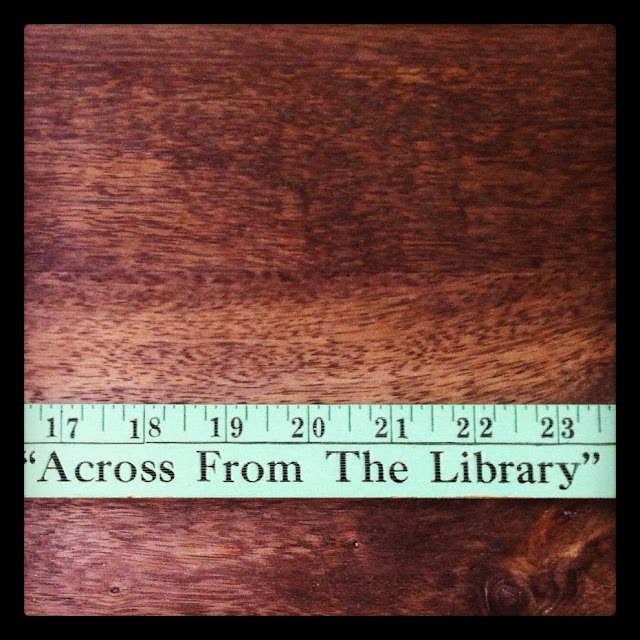
objects: yardstick

We gathered with our cousins that Thursday to clear out Grandma’s small house on Linden Road. Mother had prepared her most politically-correct suggestion: each grandchild could choose just one item of Grandma’s to take with them, but any remaining item of their choice. Mother always worked through things in an order that began at practical and eventually ended at emotional. She kept her emotions private in this way, facing it all herself only once all of the public and social expectations were long past. The aunts and uncles had already taken what they wanted from Grandma’s, though looking around that day, I didn’t notice anything missing. I must not have paid enough attention; what does that say about me? Sad, how a person makes so many choices to arrange their world around them, with no guarantees that anyone will even notice, let alone remember once they’re gone. I look around again and focus instead on all that I do remember: the dark mahogany upright piano, the orange upholstered wingback chair, the lovely grandfather clock in its regal, carved wood casing. The rest of her things would be sold off in the estate sale this weekend, to help pay the bills that were left from the funeral. 

The picking would begin with Louis, the youngest, as Mother’s reasoning suggested he had spent the least time with Grandma, and might have less connections, therefore, to her things. We would work our way up through our ages after him. Louis chose a wooden vintage radio with black dials worn shiny from regular use. The radio used to sit on the tiny green formica-topped kitchen table, so Grandma could listen to the oldies’ station as she washed the dishes each night. We let Patty pick long-distance at number two, on a phone call from Portland. She chose the three-tiered rope macrame plant stand that hung in the corner of the living room from the ornate gold ceiling hook. A very fashionable choice - Patty was always informed on the trends. On and on our choices went, through all seven grandchildren: a marbled ceramic lamp; a full poker set in a round, red leather case with gold snaps; a bonsai tree planted in a rough cement planter; and an etched mirror that had always hung in the front hall. Their choices matched their personalities perfectly, ranging from understated to ornamental, from small to large, from sentimental to valuable. In my role as oldest grandchild, I chose last. I knew just what I wanted, though I knew no one else would choose it. I had to look around a few places to find it, but finally my eyes caught its form, tucked into the corner of the spare room closet: Grandma’s old, battered yardstick.
The wooden yardstick’s edges were worn and slightly splintered from all its years of use. It was painted a dusty shade of bluish-green, printed with black letters that had worn through to show the pattern of its wood grain below, the same message pressed firmly into both sides. Grandma had the yardstick for as long as I can remember - I have no idea when, or where exactly, she got it. Yardsticks are the sorts of things that seem to come from nowhere, but are always with you, like a subsidiary family member, floating from room to room throughout the years, always belonging, but never stealing attention. It was always handy for a school poster project or for Grandma’s sewing stints. Her yardstick obviously must have come from The Carpet Center - perhaps she bought her carpet there long ago? Or maybe it was a promotional item, given away at the local hardware store as a way to draw more customers in? No one seems to have any idea of its origins, nor does it seem anyone cares to care, except for me. But we can all attest to the faithfulness of its company through all our growing-up years. I loved all the marks the yardstick had collected along the way: bits of pencil and Sharpie marker and an occasional ballpoint scribble on its painted surface, where a little brother or sister had “helped” with a project. 
The Carpet Center had closed when I was in elementary school. It was located on a small, triangular plot of land across from the library, off a main thoroughfare that edges the residential neighborhoods including our own street, Gottschalk Avenue. “Got chalk?” we quipped, when the milk campaign reminded us of our street name. We lived in an old brick apartment complex, just a few blocks from Grandma’s. We were free to roam the neighborhood as we liked, as long as we stayed within the confines of the major surrounding streets. Luckily, this included our house and Grandma’s house, as well as the Dairy Queen just around the corner from her. She was generous with her Bingo prize money anytime she had a winning streak, and would grant us each a dollar like we had somehow contributed to her success. The only thing I really remember about The Carpet Center was the fact that we could ride in triangles around the store on our bikes, without crossing any streets or alleys, just the loading driveway at the back of the shop. There were not many places in our neighborhood where you could track your progress so neatly, so simply. The triangle-block made the best race-track for all of us as we lapped around and around the block’s three sides, feeling wild and adventurous outside the usual square-block paths. I wonder if they paid any attention, from their desks inside the building, to the parade of children: varied bikes and sizes, taking turns in the lead.
“Delusions of grandeur,” my father always said, about our humble town and its street names that conjured up images of other places. “Park Avenue,” with its reference to fancy New York City, or “Vincennes,” which was most well-known for being a nearby Indiana town, but actually referred originally to a suburb on the outskirts of Paris. I had done a research project on Vincennes for school, and learned that the French town boasted both a zoo and a castle, where the Marquis de Sade was once imprisoned. I could only imagine. It was just like our town, to move your thoughts on off to something else, something far away and most definitely better. Even “Western, Kedzie, Ashland and Halstead” made you feel as if you were just a stone’s throw from the city limits where those streets belonged, when in reality, it was at least a thirty-mile drive. It always bothered me especially that one of the nearest main roads was called the “Dixie Highway.” Wasn’t that the worst of all? We had learned early in school about the Civil War, and what I learned then had already ruined one of my favorite songs on the Disney cassette: “Away, away, away down South in Dixie!” So upbeat, so triumphant, so misleading - it almost gave you understanding for those poor Confederates. Maybe the song was what had kept them going. I still loved it secretly, but felt the impropriety of claiming sympathy for the southern slave-states’ case. What was a “Dixie Highway” doing up here in Illinois, anyway?
Grandma always laughed at my literal approach as a child, the way I needed to understand a word all the way before I felt confident to use it. She had long let go of taking herself too seriously, back when she had come to America in the first place and had to learn English as a part of their new start. I helped her cook, and garden, and watched over her shoulder as she mended Grandpa’s clothes. I was satisfied just to watch, to ask her questions as I thought of them, and to catalog my observations in the neatly-organized file cabinet I liked to imagine inside my brain. But she always poked and prodded me to participate with my hands as well as my head: “Here, now you try.” My mother tried to do the same, but she watched too eagerly if I indulged her request, waiting to coach and correct my attempts, and then I would always, always fail. Grandma knew to look away, to keep her own hands and head busy as I mimicked the way she poked the tiny needle through the hem and pulled the black thread neatly through. “Good, Baby. Good.” she murmured, only once I was through. I am not sure all my stitches were good, or my plantings, or the blends of spices that I chose. But she never once betrayed any lack of confidence in my abilities. I already missed her soft affirmations, and protected them fiercely in my own memory to preserve them.
Grandma’s yardstick read THE CARPET CENTER in bold, capital lettering, followed by the address and then their well-known quote: “Across from the Library.” They had listed the phrase on all their advertising for the store, and over time it had rolled along enough different printer’s desks and newspaper ads to collect the quotation marks like a tumbleweed catches bits of leaves and debris. The shop is long-gone, but I wonder if it would have collected more quotation marks over time, the longer it was open. Would it work like that for me? Could I live a large enough life, and long enough, to garner quotation marks attached to my name? It struck me silly even when I was small, those pretentious quotation marks. Although I suppose they could have been legitimate; perhaps the quote had originated from the shop owner’s wife, who spoke them approximately thirty times a day into her light blue telephone receiver: “Across from the Library.”  
Everyone knew where the Library was. It was as good a landmark as any. After all, carpets were not the sort of thing that people shopped for regularly, and while a name like “The Carpet Center” guaranteed a clear offering of products, it did not do much to distinguish itself from other carpet retailers in the area. Homewood’s place as a part of Cook County meant the shop was included in the giant phonebooks, as well as the local ones. The free books, most commonly used as booster seats for children or step stools for housewives, showed up once or twice a year on everyone’s front step, in shades of yellow and white, and almost always decorated with accents of blue. Turn the pages to “Carpets,” and there it would be, three pages in, a square box interrupting the rest of the column, containing the same famous quotation. 
In the front hall of our apartment building, the phonebooks arrived in numbers, more books than apartments, it seemed to me. The books formed stacks tall enough for us to climb on, and I always wished I could measure them with Grandma’s yardstick, to see just how high they could tower when all stacked together. The yardstick was my favorite tool when we were small, before any line I drew freehand could even begin to resemble something straight. I liked the dependability of it - the way you could count on it to be a firm and steady guide for just about any line, and it would just keep going. I would lay the yardstick down on top of my poster paper, on Grandma’s linoleum dining room floor. Once it was positioned straight, I used my knee to keep it in place underneath my body, as I stretched out toward the top to begin my long, straight line. As I grew older, it came in handy for making charts, or for craft projects where you had to measure a string or piece of paper just right. You could measure just the same with a tape measure, I suppose, but there was the element of flexibility which made it so much harder to guarantee an accurate reading. The yardstick never bent, never changed. My friend Ana had a fancier yardstick at her house, marked with both centimeters and inches, while ours was only marked in inches: one to thirty-six. But who ever needed centimeters anyway? I never missed them.
My choice confused my brothers and sister and cousins. They knew me to be practical, sure, but hadn’t I been the one to share the most with Grandma? The most years, the most of her attention before there were others to compete. Their skepticism registered on their faces and a couple of them expressed it verbally: “Are you sure that’s what you want?” Surely there was something more ‘important’ I could claim. I wanted the yardstick for a reason I couldn’t manage to explain, for fear that it would undo me and let loose the wall of grief that had flooded up behind my older-sister dam of comfort and dependability. 
I valued the yardstick as a reminder that Grandma kept track. We couldn’t keep her house, or the wall in the upstairs hall that bore each of our growth marks. But I could hold on to the method she used to make those marks, year after year, as we celebrated our birthday and walked again to the wall to measure our year of experience in inches and feet. I remember the year when she had to make two marks for me: first, a tiny dot where the yardstick’s thirty-six inches had ended, and then the proper line, marked with my name and age, where I had exceeded its reach by two extra inches. I couldn’t believe I was finally longer than the yardstick! I remember when my brothers grew taller than Grandma, when she held the yardstick flush against the wall and pointed, as they turned around to mark their line where she could not reach. I remember the year Patty turned five, her triumph at finally passing thirty-six inches - she was always small for her age, and this self-consciousness was emphasized by her analysis of the walls with their marks from the rest of us as we grew. 
And I remember my own last mark, the year I turned twenty-one, which Grandma had determined as the age we would be fully-grown. In my last year of school, I was beginning to understand what growing up might really mean, and that I wanted my life to count in ways just as tangible as the marks on Grandma’s wall. Grandma added my age to the line that had held its place for several years now: five feet, five inches, four inches taller than she was. She touched my cheek, with her left hand and said nothing; she didn’t have to, her eyes beamed bright and proud at the woman I was becoming. Most of the kids looked at the wall as something they had done for Grandma, year after year, humoring her old-fashioned whims and routines. I looked at the wall as something Grandma had done for us.

(Read more about my "objects" writing prompt series here!)